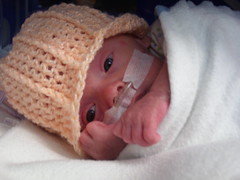
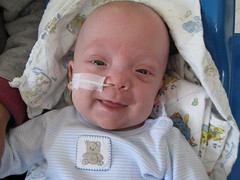
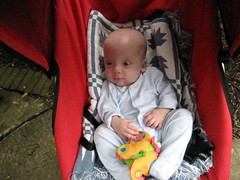
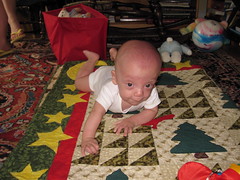
Carolyn took Max for a long-scheduled visit to the apnea/pulmonary care clinic at Children's today; this is one of the many specialists that Max is seeing. For the most part, Max put on his usual charm offensive. However, Max has a disconcerting habit of crying if he sees another child crying. For a long time we thought he was just copying his older brother, but having seen him around other babies, Carolyn confirms that he seems to pick up their distress via baby telegraph. Needless to say, there are plenty of unhappy children at Children's.
The monitor to which we attach Max every night has been recording his breathing and heart patterns, as well as any alarms, time between the alarm and its reset, and other indicators of parental diligence. We initially viewed the monitor with suspicion because we knew it would eventually disgorge all of our secrets to the pulmonary care team, but then we forgot about it.
I'm happy to say that the pulmonary care team read the monitor's memory and gave us high marks for consistent use. They also told us that the few times the alarm went off were false positives: Max's heart or breathing patterns may have tripped the alarm, but they weren't real episodes of bradycardia, tachycardia or apnea. As a hospital baby, Max has always slept peacefully through any manner of noises, including his monitor's alarm. Had Carolyn and I been hooked up to monitors over the past couple of months, however, they would have told a different story. There's nothing quite like being catapulted out of Lethe's sweet embrace by a klaxon announcing that your child needs emergency care.
The pulmonary/apnea team tried to talk us out of continued use of the monitor. After all, they said, Max has gone 43 days at home without an incident. We, however, aren't so sanguine. Max hasn't had an episode..yet. I was surprised to hear that we had been home for 43 days. I don't know if it feels like just a single day or an eternity, but there's something nice and concrete about the number: 43 days.
Max is suffering from what Carolyn calls the "family cold." We've all got it to some degree or another. Dark theories abound regarding who among us brought in the infection. For political reasons, we've decided to blame the only member of the family who can't talk, although we don't have a theory where Max might have gotten it. To some extent, Max's cold symptoms made his lung function appear temporarily worse. Nonetheless, the pulmonary team doubled his dose of diuretic in order to keep his lungs clear of fluid. We go back in a month for a further checkup.
Showing posts with label lungs. Show all posts
Showing posts with label lungs. Show all posts
Tuesday, June 2, 2009
Friday, January 30, 2009
Another big family meeting
We had a "family meeting" today; our first in two months. Max's entire NICU team assembled in a conference room adjacent to the critical care nursery: the attending, fellow, resident, Max's nurse and a social worker, plus maybe a couple other cast members took two hours out of their day to talk to us and answer our questions. I feel like writing a personal note of apology to all of the babies in the NICU because we sucked up so much of the NICU team's collective brainpower.
We learnt quite a bit: too much for me to detail tonight. I will hit the high points now and then write a longer description later. (If you stick around to the end of this post you'll be rewarded with a heart-warming story.) The attending began the discussion of each of Max's problems by asking us to describe our perception of the situation. The picture that Carolyn and I described seemed to accord well with the NICU team's in almost all cases, so there weren't (many) surprises.
I'll start with Max's head because I believe that, although it is not an urgent problem right now, many years from now we'll still be dealing with Max's hydrocephalus long after we've forgotten about his reflux or breathing problems. Thus, any kind of news about his hydrocephalus affects my vision of life in the science-fictional year of 2030 (when I hope to attend Max's college graduation). As we knew, Max has hydrocephalus, but his most recent MRI showed no sign of PVL. However, Dr. S. said that in addition to being swollen (the hallmark of hydrocephalus), Max's left ventricle was oddly shaped. I think that Dr. S. adduced that the ventricle may have flowed into an area of "lost brain". As I understand it, until now we'd been worried about the damage that Max's ventricles did to the surrounding brain tissue when they filled with CSF and expanded. However, Dr. S. seemed to suggest that, like a water balloon sitting on some Legos, one of Max's ventricles might be larger than normal because there was no brain tissue there to push back. This was all very confusing, and we asked several questions about it but couldn't quite nail down what had happened. Carolyn and I have decided to suspend our anxiety on this matter and consult with a neurologist next week. We also learnt that 20 percent of infants with enlarged ventricles go on to have some kind of motor or cognitive deficit.
We can't control what's going on inside Max's brain. However, I'm firmly convinced that aggressive therapy can ameliorate any damage. Dr. S. and the NICU team clearly relaxed when we said that we intended to sign Max up for the local early intervention program and follow the advice of speech/physical/occupational therapists. Years of graduate school have prepared Carolyn and me to compulsively follow any therapeutic regimen suggested by the experts. I also told the NICU team what they couldn't know: that Max's older brother is as sharp as a tack, and that his parents aren't dullards either. Hence, Max himself must be in line to inherit some grade A brains. This was the one comment I made that elicited hearty laughter from the whole NICU team. Perhaps Max's dad isn't as smart as he thought.
The NICU team told us that a recent assessment of Max's reflexes, behavior, etc put him at the same level as a normal baby aged one month. (Max is more than three months old.) I think the NICU team were afraid that this would dismay us, but Carolyn and I were thrilled by the news. Considering that for weeks and weeks of his early tenure at the NICU, Max wasn't even as responsive as a normal newborn infant, this is a huge step forward.
Dr. S. was quite upbeat about the state of Max's lungs. First, the bad news: the lungs were damaged by the use of oxygen therapy and respirators in his early weeks at the NICU, plus the normal underdevelopment of the lung of the premature infant. In addition, Max is aspirating his reflux (see below) further damaging them. The inflammation from inhaling liquids is what is causing his persistent pulmonary edema, which decreases the efficiency of his lungs.
Now the good news. The lung seems to be the one organ that NICU teams really love. It grows relatively quickly in relation to the infant's overall growth, and grows for a long time. By the time Max is two years old, the damaged portion of his lung will represent only a small fraction of his overall lung. Even if Max's reflux continues to damage his lung, it will grow its way out of trouble. The danger to Max's lung is that he aspirates a considerable quantity of milk and develops pneumonia: this could affect a significant fraction of his lung.
Finally, we spent quite a lot of time talking about Max's main problem: his reflux. Really, his reflux is the main reason Max is still in the hospital. I think they would have sent him home with a feeding tube by now. But when Max is fed he is very uncomfortable and is clearly feeling his stomach contents travelling up his esophagus. He vomits much more frequently now than ever before in his stay at the NICU. To Carolyn and me this reflux seemed to come out of nowhere. However, the NICU team told us that they've increased the volume that Max is getting. This is actually good news: despite his reflux and vomiting, Max is managing to get enough nutrition from his feeds that he is gaining weight. Indeed, in a very narrow sense, I believe that Max is actually maybe thriving. Some babies require supplemental nutrition via an IV. In addition, back during the dark days of mid-December, I remember Max's nurses describing his symptoms as consistent with reflux. Shortly after that, the NICU team pushed his feeding tube into his duodenum, where it was more or less impossible for milk to return to the stomach and then reflux back to the esophagus.
The NICU team are urging us to seriously consider a couple of linked surgical procedures. First is running a tube--called a g-tube--to Max's stomach directly from the outside world. This will allow us to feed him without using a feeding tube. If Max didn't have reflux but was just having trouble eating, a g-tube would allow us to take him home immediately. The second is called the Nissen procedure and involves, effectively, tightening the esophagus's opening into the stomach. This surgery elicits a lot of controversy on the Internet. Many parents seem to feel that their doctors suggest it as a way to get a baby to stop screaming in discomfort from reflux, but that the procedure itself doesn't actually do much. In adults, the procedure isn't that successful.
The good news is that the NICU team are very conservative and will consult closely with the pediatric surgeon. They're ordering a couple of barium studies of his esophagus to see whether there's a structural abnormality that might make Max a good candidate for a Nissen. We've gotten to know the surgeon quite well over the past few months because Max has come close to requiring his services at least twice. We like and trust him. He wasn't the least bit disappointed in the past episodes when Max got himself organized and avoided the surgeon's knife.
And now, the heart-warming story. Carolyn went out for coffee with a colleague this afternoon. When she returned, she found that Max's nurses had rigged up a system of pads to allow him to be slightly propped up but also comfortable. She had also set up a toy star with a little mirror on it just within Max's reach. Carolyn found Max happily reaching up and batting at the star. From her description, it seems like Carolyn spent some time just staring at the scene: a baby playing happily with a crib toy.
We learnt quite a bit: too much for me to detail tonight. I will hit the high points now and then write a longer description later. (If you stick around to the end of this post you'll be rewarded with a heart-warming story.) The attending began the discussion of each of Max's problems by asking us to describe our perception of the situation. The picture that Carolyn and I described seemed to accord well with the NICU team's in almost all cases, so there weren't (many) surprises.
I'll start with Max's head because I believe that, although it is not an urgent problem right now, many years from now we'll still be dealing with Max's hydrocephalus long after we've forgotten about his reflux or breathing problems. Thus, any kind of news about his hydrocephalus affects my vision of life in the science-fictional year of 2030 (when I hope to attend Max's college graduation). As we knew, Max has hydrocephalus, but his most recent MRI showed no sign of PVL. However, Dr. S. said that in addition to being swollen (the hallmark of hydrocephalus), Max's left ventricle was oddly shaped. I think that Dr. S. adduced that the ventricle may have flowed into an area of "lost brain". As I understand it, until now we'd been worried about the damage that Max's ventricles did to the surrounding brain tissue when they filled with CSF and expanded. However, Dr. S. seemed to suggest that, like a water balloon sitting on some Legos, one of Max's ventricles might be larger than normal because there was no brain tissue there to push back. This was all very confusing, and we asked several questions about it but couldn't quite nail down what had happened. Carolyn and I have decided to suspend our anxiety on this matter and consult with a neurologist next week. We also learnt that 20 percent of infants with enlarged ventricles go on to have some kind of motor or cognitive deficit.
We can't control what's going on inside Max's brain. However, I'm firmly convinced that aggressive therapy can ameliorate any damage. Dr. S. and the NICU team clearly relaxed when we said that we intended to sign Max up for the local early intervention program and follow the advice of speech/physical/occupational therapists. Years of graduate school have prepared Carolyn and me to compulsively follow any therapeutic regimen suggested by the experts. I also told the NICU team what they couldn't know: that Max's older brother is as sharp as a tack, and that his parents aren't dullards either. Hence, Max himself must be in line to inherit some grade A brains. This was the one comment I made that elicited hearty laughter from the whole NICU team. Perhaps Max's dad isn't as smart as he thought.
The NICU team told us that a recent assessment of Max's reflexes, behavior, etc put him at the same level as a normal baby aged one month. (Max is more than three months old.) I think the NICU team were afraid that this would dismay us, but Carolyn and I were thrilled by the news. Considering that for weeks and weeks of his early tenure at the NICU, Max wasn't even as responsive as a normal newborn infant, this is a huge step forward.
Dr. S. was quite upbeat about the state of Max's lungs. First, the bad news: the lungs were damaged by the use of oxygen therapy and respirators in his early weeks at the NICU, plus the normal underdevelopment of the lung of the premature infant. In addition, Max is aspirating his reflux (see below) further damaging them. The inflammation from inhaling liquids is what is causing his persistent pulmonary edema, which decreases the efficiency of his lungs.
Now the good news. The lung seems to be the one organ that NICU teams really love. It grows relatively quickly in relation to the infant's overall growth, and grows for a long time. By the time Max is two years old, the damaged portion of his lung will represent only a small fraction of his overall lung. Even if Max's reflux continues to damage his lung, it will grow its way out of trouble. The danger to Max's lung is that he aspirates a considerable quantity of milk and develops pneumonia: this could affect a significant fraction of his lung.
Finally, we spent quite a lot of time talking about Max's main problem: his reflux. Really, his reflux is the main reason Max is still in the hospital. I think they would have sent him home with a feeding tube by now. But when Max is fed he is very uncomfortable and is clearly feeling his stomach contents travelling up his esophagus. He vomits much more frequently now than ever before in his stay at the NICU. To Carolyn and me this reflux seemed to come out of nowhere. However, the NICU team told us that they've increased the volume that Max is getting. This is actually good news: despite his reflux and vomiting, Max is managing to get enough nutrition from his feeds that he is gaining weight. Indeed, in a very narrow sense, I believe that Max is actually maybe thriving. Some babies require supplemental nutrition via an IV. In addition, back during the dark days of mid-December, I remember Max's nurses describing his symptoms as consistent with reflux. Shortly after that, the NICU team pushed his feeding tube into his duodenum, where it was more or less impossible for milk to return to the stomach and then reflux back to the esophagus.
The NICU team are urging us to seriously consider a couple of linked surgical procedures. First is running a tube--called a g-tube--to Max's stomach directly from the outside world. This will allow us to feed him without using a feeding tube. If Max didn't have reflux but was just having trouble eating, a g-tube would allow us to take him home immediately. The second is called the Nissen procedure and involves, effectively, tightening the esophagus's opening into the stomach. This surgery elicits a lot of controversy on the Internet. Many parents seem to feel that their doctors suggest it as a way to get a baby to stop screaming in discomfort from reflux, but that the procedure itself doesn't actually do much. In adults, the procedure isn't that successful.
The good news is that the NICU team are very conservative and will consult closely with the pediatric surgeon. They're ordering a couple of barium studies of his esophagus to see whether there's a structural abnormality that might make Max a good candidate for a Nissen. We've gotten to know the surgeon quite well over the past few months because Max has come close to requiring his services at least twice. We like and trust him. He wasn't the least bit disappointed in the past episodes when Max got himself organized and avoided the surgeon's knife.
And now, the heart-warming story. Carolyn went out for coffee with a colleague this afternoon. When she returned, she found that Max's nurses had rigged up a system of pads to allow him to be slightly propped up but also comfortable. She had also set up a toy star with a little mirror on it just within Max's reach. Carolyn found Max happily reaching up and batting at the star. From her description, it seems like Carolyn spent some time just staring at the scene: a baby playing happily with a crib toy.

Saturday, January 3, 2009
On the tilted bed
Carolyn and I split the day at the NICU between us. I went in the morning, and found Max tightly wrapped in a blanket with only arm free (see picture at the bottom of this post). I held him for a couple of hours while he snoozed. (We did some arm exercises with the one unswaddled arm.) Before I left I changed his diaper and took his temperature. It's always a rodeo, made somewhat more difficult by the radical incline the NICU team have Max sleeping on. He woke up in the middle of it, and I took the opportunity to do some leg exercises too.
When Carolyn got there Max was back to sleep, but woke up when she picked him up. She took the opportunity to do more exercises. He fell asleep in the middle of a leg lift.
No medical news to report. His breathing seems a little more comfortable, thanks to the combination of ND tube, Lasix, and, maybe, radically tilted bed.
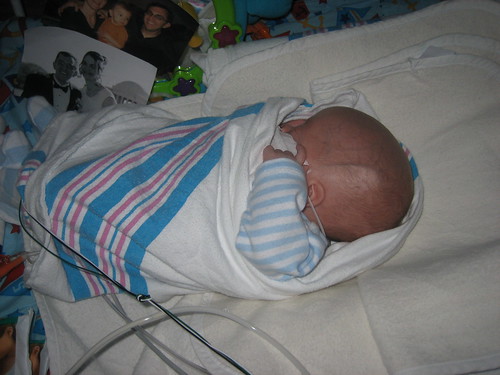
When Carolyn got there Max was back to sleep, but woke up when she picked him up. She took the opportunity to do more exercises. He fell asleep in the middle of a leg lift.
No medical news to report. His breathing seems a little more comfortable, thanks to the combination of ND tube, Lasix, and, maybe, radically tilted bed.
Friday, January 2, 2009
Lasix works
Nurse T. (a first-timer with Max---we're always surprised to meet someone new after almost three months in the NICU) reports that Max is having a quiet night. He was awake and alert for his 8:30 PM diaper change but is currently snoozing. The Lasix has continued its work all day and Max has had a series of very heavy diapers and lost 45 grams over the past 24 hours. Nurse T. got Max to suck on a pacifier. His sats remain in the high 90s, suggesting that either the Lasix or the ND tube is in fact giving him some respiratory support. However, Max is still prone to sudden but brief drops in his oxygen saturation. We think he's doing a little better on this front too, though.
Even after losing some weight, Max now weighs in at a hefty 3.3 kilos, or 7 lbs 5 ounces. One of the outfits Carolyn is dressing him has paws for feet. Also, Max now has several frog-themed outfits.
Even after losing some weight, Max now weighs in at a hefty 3.3 kilos, or 7 lbs 5 ounces. One of the outfits Carolyn is dressing him has paws for feet. Also, Max now has several frog-themed outfits.
Original due date
Today marks both Max's 10 week anniversary in the NICU and Max and Ada's original due date. In one sense, Max is now a full term baby (and at about 7 pounds he certainly weighs as much as many terms babies). In reality, though, as nice as the NICU is, a day in the NICU can't compare with a day in the womb.
Max seems to have his days and nights swapped around, so that last night--when Carolyn and I were at home--he was quite active but today--with Carolyn there all day--he was quite drowsy. Needless to say, we'd prefer Max to be the same wake/sleep schedule as the rest of the world (college students excepted). Because Max is more active at night than during the day, the nurses are getting to know him a little better than we do. They report that he likes to be picked up to be soothed.
In medical news, Max gained more than 100 grams overnight but his diapers were relatively light, suggesting that he's retaining fluids. This can contribute to difficulty breathing, so the NICU team put Max on Lasix.
Carolyn tried exercising Max and getting him to use a pacifier. In both cases he seemed more interested in sleeping than in exercising.
Carolyn did learn an interesting fact about Max's condition and the NICU team's plan for him from physical therapist S. She said that (I'm paraphrasing) when it comes to the suck-swallow motion, Max's form, his technique, is fine. However, his endurance is poor. It takes Max a lot of effort to suck or swallow, so that he quickly becomes exhausted. Why is this? Because Max is devoting a large amount of effort to simply breathing. The plan is to let Max's lung capacity develop by feeding him with an ND tube, which ought to cut down on food aspiration. S. said that all babies learn to suck and swallow; the most urgent job for Max now is to get strong.
Max seems to have his days and nights swapped around, so that last night--when Carolyn and I were at home--he was quite active but today--with Carolyn there all day--he was quite drowsy. Needless to say, we'd prefer Max to be the same wake/sleep schedule as the rest of the world (college students excepted). Because Max is more active at night than during the day, the nurses are getting to know him a little better than we do. They report that he likes to be picked up to be soothed.
In medical news, Max gained more than 100 grams overnight but his diapers were relatively light, suggesting that he's retaining fluids. This can contribute to difficulty breathing, so the NICU team put Max on Lasix.
Carolyn tried exercising Max and getting him to use a pacifier. In both cases he seemed more interested in sleeping than in exercising.
Carolyn did learn an interesting fact about Max's condition and the NICU team's plan for him from physical therapist S. She said that (I'm paraphrasing) when it comes to the suck-swallow motion, Max's form, his technique, is fine. However, his endurance is poor. It takes Max a lot of effort to suck or swallow, so that he quickly becomes exhausted. Why is this? Because Max is devoting a large amount of effort to simply breathing. The plan is to let Max's lung capacity develop by feeding him with an ND tube, which ought to cut down on food aspiration. S. said that all babies learn to suck and swallow; the most urgent job for Max now is to get strong.
Thursday, January 1, 2009
First day on an ND tube
Like lots of people all over the world, Max spent last night throwing up. However, unless there's been a sudden increase in the popularity of barium-based cocktails, I think Max was vomiting for a completely different reason than, say, the college kids who live next door to us. Max's swallowing study yesterday required him to drink some barium-laced milk, which can cause stomach upset. I think he settled down starting with him 8:30 AM feeding.
Max also got a different kind of feeding tube installed today. The NICU put in what I believe is called an "ND", or nasal-duodenal, tube (as opposed to the previous "NG", or nasal-gastric, tube). If I have this right, the tube passes through the pylorus and delivers food to duodenum. The idea is that this reduce Max's habit of inhaling the contents of his stomach that pass up the esophagus because of his reflux. The NICU team think that this "reflux aspiration" is affecting his lungs. They hope that the ND tube will lessen the reflux and give his lungs a chance to develop.
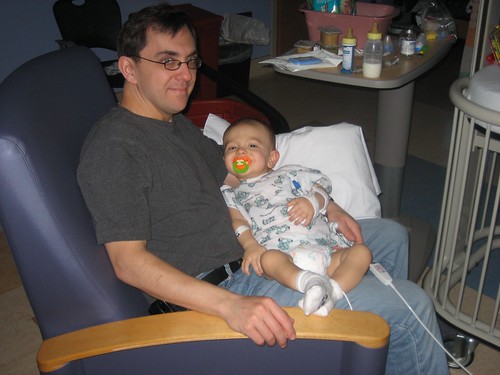
In the spirit of the season, a picture from one year ago today (we've got to quit spending the holidays in hospitals):
Max also got a different kind of feeding tube installed today. The NICU put in what I believe is called an "ND", or nasal-duodenal, tube (as opposed to the previous "NG", or nasal-gastric, tube). If I have this right, the tube passes through the pylorus and delivers food to duodenum. The idea is that this reduce Max's habit of inhaling the contents of his stomach that pass up the esophagus because of his reflux. The NICU team think that this "reflux aspiration" is affecting his lungs. They hope that the ND tube will lessen the reflux and give his lungs a chance to develop.
In the spirit of the season, a picture from one year ago today (we've got to quit spending the holidays in hospitals):
Subscribe to:
Posts (Atom)